"My purpose was simple: to catch the feel, the pulse of rock, as I had lived through it. What I was after was guts, and flash, and energy, and speed" - NIK COHN -
------------------------------------------------------------------------------------------------------------------------------------------------------------------- "When the music was new and had no rules" -LUNA C
Suddenly remembered this S.O.S. Band deep cut from their 1982 album III....
It has this clipped, staccato melody thing, that would be taken to the limit in their biggest (UK) hits "Just Be Good To Me" and "The Finest". Something I particularly associate with Jam & Lewis's songwriting for them and others (although in the case of "Looking For You" it's not actually written by them)
A post-Chic style of "melodic spacing," as discussed earlier here.
What's cool about "Looking for You" is that the staccato feel is really strong in the verses, as opposed to where it usually sits, the chorus. (The chorus in "Looking For You" is actually a little blah). In the verses, the choppiness creates a lurching quality that matches the song-character's frantic lovelorn / lover-lost state of mind. That desperation is further supported by an equally jutting distorted rock-guitar riff, that - in tandem with the prickly rhythm guitar part - exacerbates the off-balance feeling. You picture a swivel-eyed person, literally looking around trying to spot their missing lover in the crowd... catching someone with a faint resemblance out of the corner of the eye and for a second hallucinating their face.
Monday, September 27, 2021
Chic are a proof of my theory-stance-contention that the best disco is the the disco that made the charts
there is a logic to the syndrome of "the best stuff
crossed over and became pop"
for what are the premises on which disco is based, its metric?
Good beat, good groove
Strong vocal performance
Great melody
Cool shiny production
Those happen to be exactly the same premises on which
successful pop music is based - a beat you a dance to, a tune you can sing
along to it, a certain conventional idea of vocal power, bright slick shiny
production, well played etc
up to a certain point, you can say that disco-ness is poptasticness
so underground disco means simply not known by that many people,
means not that successful on its own terms
Underground disco cultists are very similar to the Northern
Soul thing
The Northern Soul people liked Motown-type music. But Motown
they considered “commercial” – meaning, simply that ordinary kids knew about it
cos it had been in the charts. So they formed a whole cut around either Motown
releases that had not been hits (cos they weren’t quite good enough)and then the Motown-wannabes, of which they
were droves. And there was so much of this second-division, solid uptempo soul
made then that they could sustain a whole culture based on it, and never play
the Four Tops or Martha and the Vandellas or the Supremes.
Eventually they moved into the third-rate and the overtly
substandard.
You get the same thing with garage punk of the Sixties –
which I was really into and I went pretty deep into the second-rate zone, cos I
loved that particular energy and set of noises and vocal aggression
But the best stuff - objectively - was either the British groups who
inspired the garage punks or those one-hit wonders like Count Five with
‘psychotic reactions’
Oh here and there you’ll come across something you think ‘this
could have been a hit, should have been a hit’
But the bulk of it is determinedly second-division and
enjoyable on that level if you are that obsessed with the sound
In the piece onChic and Sister Sledge et al, I note of Nile Rodgers & Bernard Edwards's songwriting:
"Chic favored chord changes sublimely poised between happy and sad while the choruses were staccato, the spaced-out notes seemingly plotted on graph paper."
Listening to all the ChicOrg classic-era tunes, it struck me that Nile Rodgers & Bernard Edwards were among the pioneers - perhaps the pioneers - of a stylistic feature of writing during the postdisco era, something I'd noted earlier in the year when listening to a ton of Eighties boogie and club tracks. It's particularly pronounced in the songwriting of Jimmy Jam & Terry Lewis for acts like The S.O.S. Band.
On Dissensus I observed:
One thing I've noticed recently listening to 80s club faves, is that a lot of postdisco / boogie tunes have this thing where the chorus is rectilinear - regular and spaced out notes - which creates a delicious tension with the grooviness of the music. The verse melodies tend to move in this more fluidly shimmying soulful way.
The choruses sound clipped - there don't tend to be long held notes, and there's rarely melisma or trills or any kind of flourish. Instead it's all about precision and staccato starkness.
Odyssey's "Inside Out" is a good example - and a wonderful song / vocal performance, from Lillian Lopez (with this ever-so slightly harsh nasally timbre and sort of yearningly imperious tone).
(Also the lyric is a bit peculiar, if you pay attention to it - "When you're lying in her bed / And you're in her arms instead of my love /As you feel her tightening grip...." Beg pardon ooer missus .... and then "And she's always on that phone / And you just don't think that you got the strength to fight it" - the fantasmic scenario dreamed of by the rival-in-love singing the song seems to be "hold on, I'm coming to your rescue", which may not be the male's feeling about the situation at all)
Cheryl Lynn's marvelous "Encore" (written and produced by Jam & Lewis) is another prime case, with the spacing-out effect exacerbated by breaking up the chorus so that it's a sort of lurching back and forth between two voices (Cheryl and a backing singer, or it is Cheryl multitracked?).
(Listen to the fade of the 12-inch for the "all right!" as used in "Radio Babylon" and a thousand (slight exaggeration) rave tunes)
Change's Chic-like "Change of Heart" (written, arranged and produced by Jam & Lewis) has the melodic spacing in the chorus in full effect. But the verses are also quite rectilinear (not sure if that's the right word but I'm sticking with it). It's a very controlled sounding record.
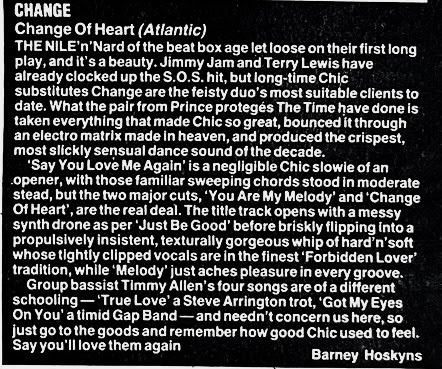
Barney H in 1984 pegs Jam & Lewis as beatbox-era successors to "Nile 'n' Nard" and mentions "tightly clipped vocals" are key to the tradition of Chic Org hits like "Forbidden Lover".
As heard in "Change of Heart", this kind of chorus as was a hallmark of Jam & Lewis's writing, as with S.O.S. Band and particularly this tune "The Finest"
Melodically "The Finest" has that "plotted out on graph paper" quality - and Mary Davis's singing is just as restrained and near-formal as the melody is - which suits the kind of amorous constraints under which the song's character lives, a satellite of love.
But then that exquisitely prim poise is blown with a horrible section that's all melismatic and oversouled, shattering the mood completely.
Apart from that thankfully brief excrescence, the whole of "The Finest" from the drum machine rhythm-track upwards, feels like a grid - or like a set of grids superimposed over each other.
And of course nuumologists need no reminding what eternal anthem it led to...
Jam & Lewis have similar things going on with certain Janet Jackson tunes and also Human League's "Human".
Rewinding to a few years earlier - Kool and the Gang's "Get Down On It" - I remember at the time this originally came out thinking that it had a curious quality of geometry, an oddly orderly symmetry.... but in this case that tension, the play of rigidity against loose 'n' groovy, is at work at all levels of the instrumentation not just the vocal melody.
^^^^^^^^^^^^^^^
A recurrence of that kind of feel - spaced-out, tautly controlled, geometric - comes in the late '90s with Timbaland, especially the Aaliyah tunes. Here the spacing is even more strikingly stark, huge gaps in the drum programming. Aaliyah often sings as if she's tip-toeing, the voice padding across the stave with a feline wariness
Bringing it around to where we started, I discover that Timbaland engineer Jimmy Douglass actually produced Odyssey's "Inside Out" (one of his other clients around that time was Gang of Four for Solid Gold). "Inside Out" was actually written by Jesse Rae, a Scotsman so steeped in funk and R&B that he could fluently write in the idiom and pass for the real thing (in the late 80s I interviewed him about his own excellent music).
^^^^^^^^^^^^^^^^^^^^^^^^^
Here's a rather good white copy of postdisco geometrics - the tune feels like glistening planes intersecting in space, like a mobile made of colored glass
^^^^^^^^^^^^^^^^^^^^^
bonus beats: later thoughts on melodic spacing in discofunk and postdisco
S.O.S. Band's "Looking for You" (1982)
This has the clipped, staccato melody thing that would be taken to the limit in S.O.S. Band's biggest (UK) hits "Just Be Good To Me" and "The Finest". It's something I particularly associate with Jam & Lewis's songwriting for them and others (although in the case of "Looking For You" it's not actually written by them)
What's cool about "Looking for You" is that the staccato feel is really strong in the verses, as opposed to where it usually sits, the chorus. (The chorus in "Looking For You" is actually a little blah). In the verses, the choppiness creates a lurching quality that matches the song-character's frantic lovelorn / lover-lost state of mind. That desperation is further supported by an equally jutting distorted rock-guitar riff, that - in tandem with the prickly rhythm guitar part - exacerbates the off-balance feeling. You picture a swivel-eyed person, literally looking around trying to spot their missing lover in the crowd... catching someone with a faint resemblance out of the corner of the eye and for a second hallucinating their face.
Chic's "Good Times" (1979)
The spacing thing is going on not just in the chorus but the verse melody too. No long held notes, no melisma. Discernible gaps between notes, each sung note like a taut dab of sound. There's a almost prim clipped-ness. A delicious tension is created by the relative non-fluidity of the melody line (which is also a horizontal melody, not a vertical one - its catchiness is through the rhythmic patterning rather than moving up and down and around the octave).
These are characteristics of nearly all of Rodgers & Edwards's big hits for Chic and Sister Sledge.