A round-robin retrospective on Artificial Intelligence, Warp's landmark compilation - now 30 years old, Jesus, and being commemoratively reissued - convened by Daniel Dylan Wray, for The Quietus. I am one of the voices corralled. As you can imagine, the colloquy contains a fair amount of complaining, from various angles, about the term / genre / discourse "Intelligent Dance Music" a.k.a. IDM, which the comp unintentionally launched. "Electronic Listening Music", as flagged up on the cover itself, would have made for a much better, more neutral and non-inflammatory term (although even there's a subliminal hint still of a "music for the mind versus music for the body" dichotomy, with the implicit suggestion that people who are dancing are doing so mindlessly, they're not really listening).
There were a few responses of mine that were not used, and being a waste-not-want-not type (a child if not of the era of rationing then of someone who lived through rationing, which lasted up until 1956, right?), here are those morsels.
Asked about the argument that IDM is a white cooptation of back music, I offered this demurral:
"I didn’t really feel that was a factor. After all, there is a huge European history with electronic music – Kraftwerk, Tangerine Dream, Eno. A lot of postpunk and industrial. And a Japanese history too, with Ryuichi Sakamoto and YMO. But also with most of the IDM artists, they would be the first to acknowledge being inspired by Detroit techno and the early Chicago acid and so forth. I think there was a commonality felt with figures like Carl Craig and great respect for Underground Resistance and so forth.
"Where that became more of a thing was a bit later when you had the first-wave IDM artists adopting jungle’s breakbeat science techniques and then exaggerating them to the point where it was daft and undanceable. And there was a bit of attitude that irritated me then which was “look at us, we’re taking these ideas much further than the Junglists, who are all sheep, pandering to the dancers and the deejays”. It was an odd combo of coopting and arrogance. In fact, they weren’t taking the techniques any further than Dillinja or DJ Hype, they were just making them dysfunctional."
Quizzed about being "involved" in the IDM List and whether it was a real musical community.
"I wasn’t involved really, I don’t think I ever
commented in a thread. But I checked it out, I subscribed to the list – just to
see what people were talking about and how they talked about it. Being a
student of discourse and fan rhetoric, I was interested to see how this
unexamined superiority complex manifested in terms of judgements about which
music mattered and why.
"I liked a lot of
that kind of music – pretty much all the big names in IDM I thought were great
or very interesting, and many of the smaller artists. Some of it is among the
most beautiful music ever. I think its strong suit was melody and emotion. Well,
you had interesting textures and sounds and atmospheres, but particularly
melody and emotion was what it had to offer. If it had been called “emotronica”
(admittedly a ghastly word!) then that might have been better. Not that
hardcore dance musics are devoid of emotion, but it tends to be quite
primary-color, unsubtle emotion, whereas in
Aphex and Boards of Canada, et alc, you have a subtle palette of feeling
– it can be poignant, eerie, mystical.
And finally, thoughts on the legacy of Artificial Intelligence:
"As I mentioned, I don’t think it’s that great a
compilation, as a collection of tracks. There’s some good things and then as
often with comps, the guest artists offer things that are maybe not their best
work. It wasn’t a record I played more
than a couple of times, I shouldn’t think. It’s more the throw-down of the title
and the iconic cover image – it all added up to this big statement that Warp
were making. Along with some of the things that were building in ’92 through to
early ’93, the release really opened up a whole area of music that just grew
and grew. Up to that point, you’d a few really excellent techno/house albums – 808
State’ 90 and Ex:Cel, LFO’s Frequencies, Ultramarine’s Every Man and Woman Is A
Star. But it didn’t necessarily seem like a massive zone for the future. A lot
of techno artists stumbled when it came to the album. But
then I think with this comp, coming out at around the same time as Selected Ambient Works 85-92, suddenly it seemed a whole new space of possibility opened
up.
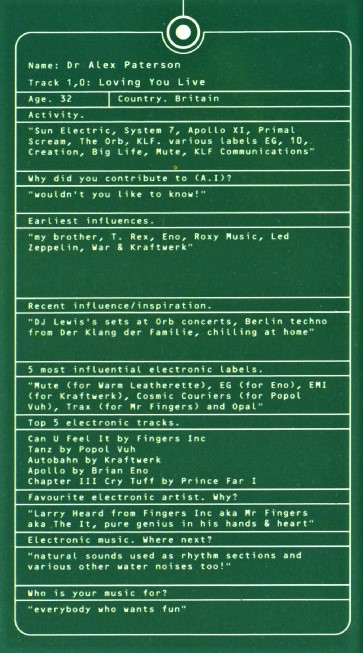
From Artificial Intelligence's liner notes
Autechre's formative influences - almost all black music but as much electro and Miami Bass as house or techno
Whereas Aphex Twin's earliest come from elsewhere altogether (Tomita!) (I was wondering who the hell Phonic Bod was and it turns out to RDJ's very first alias!)
B-12 'fess to completely Angloid roots
The Black Dog go even further back - to heathen times! (Their more recent canon is entirely postpunk / avant-funk / industrial)
The Orb, as you'd expect, place their sound amid a jumble of ambient, acid house, Krautrock, and dub lineages
Here's a "Contextual Mix" that Autechre
created to go with the anniversary of Artificial Intelligence - what sorts of music were happening around that time - 92-93